
Customer Pricing Record
The Customer Pricing Record screen or modal allows you to set parameters for a new customer pricing record, edit an existing customer pricing record, or create a copy of an existing record.
Customer Pricing records are only recognized by the system if the Utilize Parts Customer Discount Pricing field is enabled on the System Settings - Location screen. If the Your Savings field is also activated, invoices created for customers with a pricing record will include a "Your Savings" line, displaying the total sales price reduction that was applied.
Topics in this section are:
Screen Description
The legacy Customer Pricing Record screen opens from the Customer Pricing listing. To edit or copy a record, move the cursor over a Customer/Group name and select View/Edit or Copy from the pop-up menu.
For each selection field, you must have either a value on the left side or select the All option on the right. If no value is entered on the left side, you must select or All on the right.
 Fields that must either have a value or select All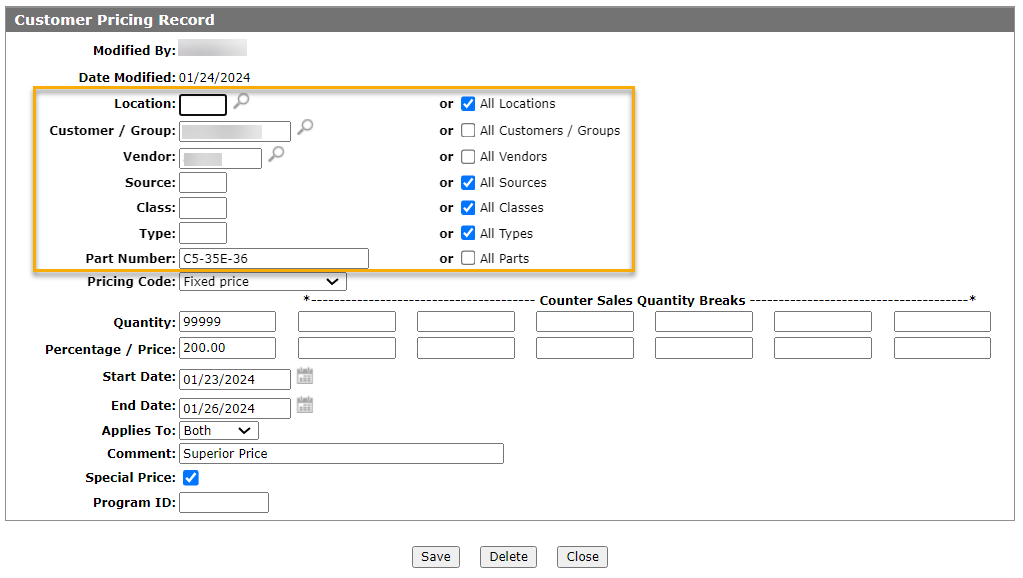
Setting Up a Customer Pricing Record
-
Navigate to Product Support > Parts > Customer Pricing.
-
Click the Need to create a new customer pricing record? Click here to add link.
-
Fill in the fields, referring to the table below.
-
To save the new customer pricing record, click Save.

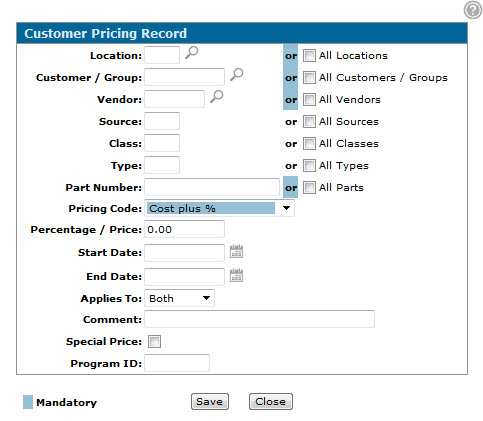
Note: The fields and buttons on the legacy Customer Pricing Record screen may change depending on the method you use to access it.
The fields on the Customer Pricing Record screen are:
| Field | Description |
|---|---|
| Location/All Locations | Applies the selected customer pricing record to a single location or all locations. |
| Customer/Group/All Customers/Groups |
Applies the selected customer pricing record to a single customer or group, or all customers and groups. Enter PARTMAST as the customer code to create a global pricing rule that applies to all customers. See About PARTMAST (Global Parts Pricing). |
| Vendor/All Vendors | Applies the selected customer pricing record to a single vendor or all vendors. |
| Source/All Sources |
Applies the selected customer pricing record to a single source code or all source codes. Source of supply codes are applied to parts to separate them into different categories within each vendor. |
| Class/All Classes | Applies the selected customer pricing record to a single class or all classes. |
| Type/All Types | Applies the selected customer pricing record to a single part type or all part types. |
| Part Number/All Parts |
The number of the part being priced, or select all parts to apply the customer pricing record to all valid part numbers within the system. |
| Pricing Code |
The pricing code for the customer pricing.
|
| Quantity |
Part quantities are entered here. Price breaks based on quantity purchased can also be configured under the Counter Sales Quantity Breaks rows. If Applies To is set to Counter:
If Applies To is set to Shop or Both:
|
| Percentage/Price | The pricing percentage or the price the part should be sold for. |
| Start Date | The day the customer pricing starts. |
| End Date | The day the customer pricing ends. |
| Applies To |
Indicates where to apply the pricing record. You must set the Quantity breaks appropriately for these options: |
| Comment | Optional. Used for notes regarding the pricing. |
| Special Price | Indicates a part pricing record that should be used regardless of whether the price calculates as higher or lower than any other pricing prices (or existing part price levels).
Note: You should use special pricing sparingly and only when necessary. When the Special Price checkbox is selected, the system stops looking and uses that pricing, even if other customer pricing records are applicable for the part. |
| Program ID | Identifies the record as part of a group of common customer part pricing programs. |
Use these buttons to complete your work on the Customer Pricing Record screen:
| Button | Function |
|---|---|
| Save | Saves changes made on the Customer Pricing Record screen. |
| Delete |
Deletes the selected customer pricing record from the system. This button only appears when you open the record by moving the cursor over a customer or group on the Customer Pricing screen and selecting View/Edit from the pop-up menu. |
| Close | Closes the Customer Pricing Record screen without saving and returns to the Customer Pricing screen. |
About PARTMAST (Global Parts Pricing)
PARTMAST is a special placeholder customer code (short for "parts master") that defines global parts pricing rules not tied to any individual customer or group. It is not an actual customer account. Use a PARTMAST pricing record to set universal pricing adjustments that apply to all customers and all parts when no more specific customer or group pricing exists.
Pricing Evaluation Order
When a part is added to a parts invoice or requisition, IntelliDealer checks for special pricing records in this order:
-
Customer-specific pricing
-
Customer-group pricing
-
PARTMAST (global) pricing
The system applies the best (lowest) price available for the customer and part combination, unless a record is flagged as Special Price, which forces that price regardless of other applicable discounts.
Key Rules
-
All Parts only: A PARTMAST pricing record must apply to all parts. The Part Number field must be set to All Parts. You cannot specify an individual part number when using the PARTMAST customer code.
-
Percentage or formula-based pricing codes only: Use pricing codes such as List Minus or Cost Plus with PARTMAST. The system does not allow a Fixed Price code with PARTMAST because a single fixed price for all parts is not valid.
-
Broadest pricing level: PARTMAST pricing is a fallback for cases not covered by customer-specific or customer-group pricing. A customer-specific or customer-group price takes precedence over a PARTMAST rule if it yields a lower price.
Example
To run a universal 10% parts discount for all customers, create one PARTMAST pricing record with Customer set to PARTMAST, Part Number set to All Parts, and Pricing Code set to List Minus 10%. This single record applies the discount across the entire parts catalog. Any existing customer-specific or customer-group pricing that offers a greater discount still applies.