
Worldpay: Daily Usage
These examples of daily usage of the Worldpay interface pertain to Parts Invoicing, but the functionality is similar in Work Orders, Equipment Ordering, Rental, and General Invoicing.
Parts Invoicing, Work Orders, and Equipment Invoicing allow sale-type transactions when you finalize the invoice without going to the A/R Agency tab first and you use a payment device. This is similar to what you would see in a retail store. When you go to the A/R Agency tab before invoicing, the system performs an authorization and captures the payment when you invoice, release, or bill the equipment invoice.
The Sale or Authorize button on the A/R Agency tab shows which Worldpay process is in use. If the button is Sale, the charge is a sale (authorization and capture together). If the button is Authorize, the charge is an authorization and a later capture is required. Other actions on that tab, including Use stored credit card and text-to-pay, use the same process. Debit cards can be used only when the button is Sale.
Real-time Billing does not by itself change whether Worldpay processes a sale or an authorization. The button on the A/R Agency tab determines the process.
Rental Contract Invoicing captures authorized credit card payments when the rental invoice is billed from the Invoicing tab or through a rental billing run. General invoicing follows an authorize-then-capture workflow. See Credit Card Processing Overview for module-specific behavior.
Should IntelliDealer fail the capture after a successful authorization, IntelliDealer still invoices as if everything is fine. The billing runs will put the authorization in authorization maintenance, where it is your responsibility to address the issue, and if necessary get payment another way.
If there is an authorize but no capture, and the previous authorization is more than six days old, then IntelliDealer displays the Accounts Receivable tab when trying to process the transaction.
See Authorization Maintenance.
Prerequisites: Complete the Worldpay Setup.
Miscellaneous Customers
A miscellaneous customer is a temporary or one-time customer record used for walk-in or non-account transactions. Miscellaneous customers do not store customer-specific information, such as saved payment methods.
Modifying Customer Cards
Note: Saving card data is not supported for miscellaneous customers. The Allow save card option and access to stored cards are disabled for these customers.
-
Locate the desired customer in IntelliDealer by navigating to Customer Care > CRM > Customer Profile and searching for the customer.
-
With the customer profile open, click the A/R Agency tab.
-
Locate a Worldpay agency card. You can choose to Allow save card or you can choose Do not allow save card. If you save the card, then the customer does not have to swipe it for each transaction. A saved card is considered Card not Present and incurs extra cost for the merchant.
Note: IntelliDealer does NOT store the actual credit card on your system. It stores a token used to access the credit card. The actual credit card number is stored on Worldpay servers.
-
Optionally, you can also click the
 to see any saved cards.
-
To remove the stored accounts, place a check mark beside them and then click the Delete button before you click Close.
 The A/R Agency tab


Invoicing a Customer
Prerequisites: You must have a credit card device assigned to your user (see Set Worldpay as the Cash Code for MyDealer Customers), or you will be unable to invoice. When using a physical device, you can only accept payments for invoices created in the same location as the device.
-
Create an invoice, selecting the proper agency or cash code for a credit card. For an example, see Creating a New Parts Invoice.
-
Click Invoice.
If you do not have any buttons, you need to assign your user to a credit card device. See Worldpay: Register Credit Card Devices.
-
If you want to store this credit card for a future transaction, the Save credit card checkbox and Alias field must be filled out before you click Authorize.
Note: If you have provided the ability to save cards in the customer profile, you will see the Save credit card checkbox, Alias, and the Use stored credit card button. See Step 3 above in the Modifying Customer Cards section.
Using stored cards is considered 'Card not present' by the credit card companies. It also has the highest transaction fees associated with credit cards. -
Click Authorize, and the credit card device will light up.
The credit card device initially displays an authorization screen showing the invoice number (for example, 01.01.A1.042318), customer (for example, 01.01.SMITH001 - Bill Smith), and amount.
-
Click Yes to continue.
The device asks you to swipe or insert the credit card.
-
Complete the transaction on the device:
-
If the credit card or debit card has a chip, insert the card, otherwise swipe, and complete the prompts.
-
If you want to perform a 'card not present' you can manually enter the credit card numbers following the procedure for your device.
-
If you want to cancel the transaction follow the procedure for your device.
-
If you want to use a stored credit card, either click the magnify glass beside Use stored credit card or press the Use stored credit card button. You do NOT need to fill in the checkbox or alias fields.
-


Using Stored Cards
The ways you can use a stored card are:
Note: Stored cards cannot be used for miscellaneous customers. Because miscellaneous customers do not retain saved payment information, the Use stored credit card option and related UI elements are disabled when a miscellaneous customer is selected.
-
Click the Use stored credit card button.
-
The card selection window appears.
-
After you select a card, the charge is automatically posted to Worldpay.
-
-
Click the magnifying class next to Use stored credit card label
-
The card selection window appears.
-
After you select a card, you are returned to the A/R Agency tab.
-
You must then click the Use stored credit card button.
-
If you click the Sale button, IntelliDealer will use the credit card device or the Worldpay portal, depending on your chosen device.
-


Canadian Usage
Using Worldpay devices in Canada is almost identical to what is described above, with one exception.
If the location is in French, the device's greeting is in French. Should a user whose language is registered as English on the credit card use the device, the device switches to English once the transaction has started. To have English labels, the customer's preferred language in IntelliDealer must also be English.
You can set the customer's preferred language in their Customer Profile.

Worldpay Portal Usage
This feature allows a user to enter the credit card information into a window that is hosted by Worldpay and for IntelliDealer to recognize the transaction. It does not require the use of a physical device to provide this functionality.
You cannot use the Worldpay Portal to perform a refund. Instead, use a stored card or previous invoice.
Prerequisites: Complete the Enabling Worldpay Portal instructions.
-
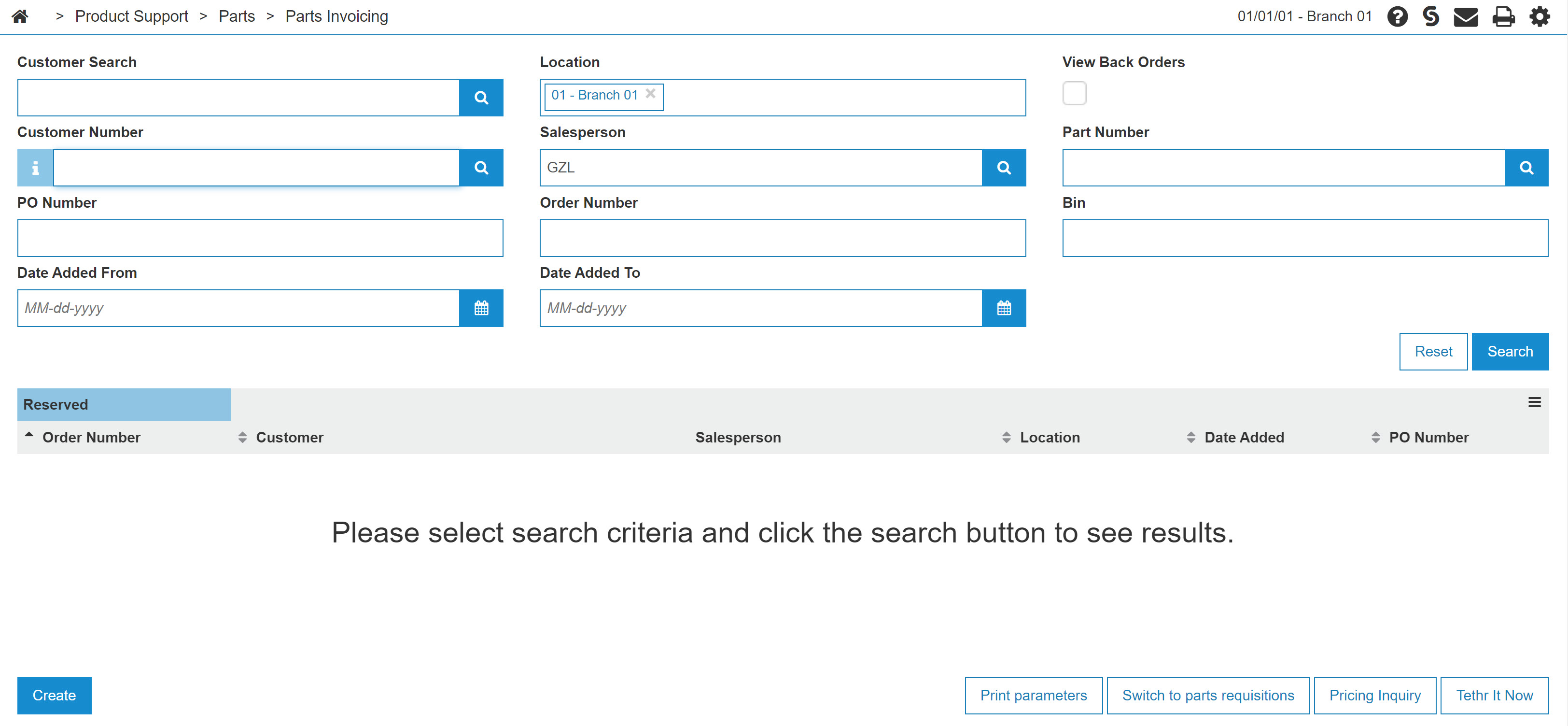
Navigate to Product Support > Parts > Parts Invoicing.
-
Click the Print Parameters button, located at the bottom right of the screen.
-
Click the link beside Point-Of-Sale Device.
-
From the list of devices, select Worldpay Portal, then click Save.
-
Search for your Invoice.
This feature works with Parts Invoice, Work Orders, Equipment Invoices, Rental or General Invoicing.
-
Edit your invoice as required.
-
Choose the cash code or GL account (depending on which invoice application you are using) for Worldpay.
-
Open the A/R tab or click the required button to invoice.
-
Click the Sale or Authorize button.
-
Fill in the details and click the Process Transaction button.
A Worldpay window opens into which you can enter the customer's credit card information.


Duplicate Transaction Checking
By default, IntelliDealer performs a Worldpay duplicate transaction check when you submit a payment during invoicing. IntelliDealer evaluates the customer, invoice date, and invoice amount. Use Accounts Receivable - Cash Codes to configure duplicate checking on cash codes that use Charge Type WorldPay.
When duplicate checking is enabled and Worldpay determines the transaction is a duplicate, Worldpay returns “There is a transaction already created for the same amount for this customer” and IntelliDealer displays an error message.

To allow legitimate charges that share the same customer, date, and amount (for example, multiple rental contracts invoiced the same day), select the appropriate Disable Duplicate Check For … option on the cash code for parts invoicing, service (work orders), equipment invoicing, or rental. Disabling duplicate checking increases the risk of accidental duplicate card charges; use these options only when your process requires same-day duplicate amounts for the same customer.
When duplicate checking remains enabled, you can post a similar charge by changing the invoice amount by at least one cent.
Note: General invoicing does not have a separate disable duplicate check option. Duplicate checking follows the default behavior for those transactions unless you change the amount.
Credit Card Details on Printed Invoices
Worldpay invoices print credit card details such as a masked card number, authorization number, and related approval text after the invoice totals. When capture occurs during invoicing, the approved amount usually matches the invoice total. When capture is deferred through Authorization Maintenance, the approved amount on the printed invoice can differ from the final invoice total if the amount changed between authorization and capture.
For all modules, agencies, and cash code print format setup, see Credit Card Details on Printed Invoices and Accounts Receivable - Cash Codes.
Payment Cutoff and Funding
Worldpay next-day funding uses a 7:00 p.m. Eastern Time cutoff. Worldpay cannot change this batch time for a dealer. If a capture is not in Worldpay’s batch by 7:00 p.m. Eastern, funding waits until the next Worldpay batch.
Sale Versus Authorize
The paths for posting Worldpay credit card invoices are:
-
Sale—authorization and capture occur together when you complete invoicing. Parts invoicing and work orders can use this path when the A/R Agency tab shows Sale, typically with a payment device. Debit cards are available only on this path.
-
Authorize then capture—the authorization is stored when you take payment, and a later process captures the funds with Worldpay. This path is used for batch parts invoicing, pre-authorizations that are completed later, rental, equipment, and general invoicing. Billing moves the authorization into Authorization Maintenance. The capture job completes the capture with Worldpay.
IntelliDealer Capture Job (#CO25)
When capture is deferred, the capture job finalizes the invoice with Worldpay. When the capture job runs depends on how the dealership is hosted:
-
Cloud ASP—the capture job runs during the full database process (#CCPTER) and the shortened day end (#DAYEND). It also runs from the job scheduler at 1:50 a.m. Monday through Saturday, with an extra run Saturday at 11:50 p.m.
-
On-site systems—the capture job runs during the shortened database or day end, or during a full reorganize on a dedicated system.
If the capture job runs after the Worldpay cutoff of 7:00 p.m. Eastern (4:00 p.m. Pacific), authorize-then-capture items wait until the next Worldpay batch. Dealers can see an extra day before those payments are funded.
For example, a rental invoice is posted today at 2:00 p.m. Eastern. The authorization is stored. A billing run at 10:00 p.m. Eastern moves the authorization into Authorization Maintenance. At 1:50 a.m. the next morning, the capture job captures the rental invoice with Worldpay. Worldpay includes that capture in the 7:00 p.m. Eastern batch the next day.