
Configuration: CNH Data Exchange Platform
Use the CNH Data Exchange Platform screen to configure CNH DEP integrations, including work order and point-of-sale transmits, eWarranty searches, My Fleet defaults, equipment inventory settings, and daily parts pricing updates from CNH.
To access the screen, navigate to Configuration > Interfaces > CNH > CNH Data Exchange Platform.
Topics in this section are:
See also:
Before you Begin
Read this section before you begin using the CNH Data Exchange Platform interface. It contains initial installation steps and helpful information for daily usage. Topics in this section are:
Prerequisites
Prerequisites:
-
Feature 6429 - CNH Data Exchange Platform must be enabled.
-
Valid DEP credentials must exist on the CNH: Credentials screen.
-
The CNH User ID must have access to eWarranty as part of DEP enablement.
Configuration Scope
Tabs on the CNH Data Exchange Platform screen store settings at different levels—dealership-wide, by company, by division, or by location. When you create a list-based record, the company or division you select is fixed after you save the record. Plan your setup so each company, division, or location that participates in DEP has the configuration it needs.
Configuration scope by tab is:
| Tab or area | Applies to | Description |
|---|---|---|
| Main | Dealership | PDF error report user, SRT job code hours, and DSA Acknowledgment apply to all CNH DEP activity. |
| Work Orders > Makes | Company | One make list per company. The company is fixed after you save the record. Work order transmits and equipment (whole goods) PoS transmits use the list for the company on the work order or invoice. If you operate multiple companies, create a separate record for each company. |
| Work Orders > Service Components | Location | One location record per company, division, and location. Each location record holds the part number to service component mappings used when work orders at that location are transmitted. |
| Work Orders > Historical Data Transmit | Manual job | No stored configuration. Each transmit is a one-time job that uses the settings on the Makes and Service Components sub-tabs. |
| Ownership Group | Division | One CNH primary Ownership Group account ID per division. Create a separate record for each division that transmits work orders to CNH. |
| Part Vendors | Division | One part vendor list per division. The division is fixed after you save the record. Parts invoice transmits use the list for the division on the invoice. |
| eWarranty search settings | Dealership | Automatic PIP/PPP search and serial number search options apply to all eligible work orders. |
| eWarranty make list | Division | One or more equipment make codes per division. Add a separate record for each make you want included in PIP/PPP lookup for that division. |
| PoS | Manual job | No stored configuration. Each transmit is a one-time job. Parts invoice data uses the Part Vendors settings for the division on each invoice. Equipment (whole goods) invoice data uses the Makes Sub-Tab settings for the company on each invoice. |
| My Fleet | Location | One default CNH brand per company, division, and location. Create a separate record for each location that opens CNH My Fleet. |
| Price File | Dealership | Vendor, country, nightly processing, reporting options, and vendor-to-brand mappings for CNH DEP daily parts pricing updates. Applies to all CNH DEP price file activity. |
| Equipment Inventory > Makes | Company | One make list per company. The company is fixed after you save the record. Daily and historical equipment inventory transmits use the list for the company on the equipment. |
| Equipment Inventory > Historical Data Transmit | Manual job | No stored configuration. Each transmit is a one-time job that uses the settings on the Makes sub-tab. |
Initial Configuration
Use this checklist the first time you configure CNH DEP for your dealership. Complete the steps in order. See also: Configuration Scope for how many records to create at each level.
| Step | Description | Topic |
|---|---|---|
| 1 | Complete the prerequisites, including valid DEP credentials. | Prerequisites
CNH: Credentials |
| 2 | Select the PDF Error Report User ID, set Update Existing Job Code Hours with CNH SRT Hours if required, and accept the DSA Acknowledgment. | Main Tab |
| 3 | Create one make list for each company that transmits work orders to CNH. | Makes Sub-Tab |
| 4 | Optional: Map part numbers to CNH service components for each location that transmits miscellaneous charges. | Service Components Sub-Tab |
| 5 | Enter the CNH primary Ownership Group account ID for each division. | Ownership Group Tab |
| 6 | Configure part vendor lists for each division that transmits parts invoice data to CNH. | Part Vendors Tab |
| 7 | Configure PIP/PPP search settings and add equipment makes for each division. | eWarranty Tab |
| 8 | Optional: Set a default CNH brand for each location that uses CNH My Fleet. | My Fleet Tab |
| 9 | Optional: Create one make list for each company that transmits equipment inventory to CNH. | Makes Sub-Tab |
| 10 | Optional: Configure CNH DEP daily parts pricing when your dealership uses CNH DEP for price updates. Set the vendor, country, reporting options, and vendor-to-brand mappings on the Price File Tab. | Price File Tab |
| 11 | Add the CNH Privacy Statement to equipment quotes and invoices. | CNH Privacy Statement |
CNH Privacy Statement
Before CNH DEP work order and point-of-sale data is transmitted, your dealership must include the CNH Privacy Statement on quotes and invoices. CNH requires this message for all DEP participants. Add the privacy text to each quote and invoice type your dealership uses, for each location. The options are:
-
Option 1—Contact the IntelliDealer forms team for a quote to embed the privacy URL or a QR code directly in your overlays. A QR code can only be used with this option.
-
Option 2—Add the privacy URL to invoices and quotes yourself using Invoice Quote Messages. A QR code cannot be used with this method. The steps below show how to add the text to Equipment Invoice/Quote messages; repeat the same process for each other quote and invoice type and location that participates in DEP.
To configure Option 2:
-
Navigate to Configuration > General Ledger > General > Invoice Quote Messages.
The Invoice/Quote Messages screen opens.
-
Select the Equipment Invoice/Quote link.
The Equipment Invoice/Quote Message screen opens.
-
Add the following text:
"By making this purchase, you acknowledge and agree to CNH Industrial's privacy practices as described in our Privacy Notice available here (https://www.mycnhistore.com/us/en/default/privacynotice)."
Or, for dealers in Quebec:
"En effectuant cet achat, vous reconnaissez et acceptez les pratiques de CNH Industrial en matière de confidentialité telles que décrites dans notre declaration de confidentialité disponible ici (https://www.mycnhistore.com/ca/fr/default/privacynotice)."
Ongoing Tasks
After initial configuration, most CNH DEP transmits run automatically when work orders change, parts or equipment invoices post, or equipment inventory updates. Use the sections below for tasks you perform on a regular schedule or as needed.
Daily
-
Review the PDF error report sent to the PDF Error Report User ID configured on the Main Tab. The report summarizes successful CNH DEP transmits and lists errors from the previous day. See Troubleshooting for how to monitor activity when no PDF user is configured and for how to investigate errors.
-
When Automatically Search PIPs/PPP on Work Order is enabled on the eWarranty Tab, respond to PIP and PPP notifications when users open or update work orders.
-
When Check for Updates Nightly is enabled on the Price File Tab, review the CNH DEP price file job history and any PDF report sent to the configured PDF user after the nightly run completes.
Weekly
-
When CNH DEP transmit errors appear in the PDF error report or batch job details, see Troubleshooting.
Monthly
-
Review make lists, part vendor lists, ownership group IDs, and service component mappings when your dealership adds locations, divisions, companies, equipment makes, or part vendors. Update the relevant tab when configuration no longer matches your business.
Ad Hoc
-
Submit historical work order data from the Historical Data Transmit Sub-Tab on the Work Orders Tab when CNH requests a work order back-fill.
-
Submit historical parts or whole goods invoice data from the PoS Tab when CNH requests a point-of-sale back-fill.
-
Submit historical equipment inventory data from the Historical Data Transmit Sub-Tab on the Equipment Inventory Tab when CNH requests an equipment inventory back-fill.
-
Upload service component mappings in bulk from the Service Components Sub-Tab.
Troubleshooting
Use this section to monitor CNH DEP transmits, review batch job results, and resolve common configuration problems. Most automatic transmits (work orders, parts and equipment invoices, and equipment inventory updates) run without action on this screen after initial setup.
Monitoring Transmits
The primary way to monitor CNH DEP activity is the PDF error report. On the Main Tab, configure PDF Error Report User ID to an IntelliDealer user who monitors the CNH integration. That user receives a PDF report from nightly and manual CNH DEP processes. The report confirms successful transmissions and lists errors from the previous day so the recipient can follow up.
If no PDF user is configured, review CNH DEP activity on Administration > Settings > Batch Jobs instead. See IntelliDealer Batch Jobs for descriptions of CNH jobs.
When you submit a manual transmit or bulk upload from this screen, a success message confirms that the batch job was queued. That message does not mean CNH has received the data yet. After the job completes, review the job run on Administration > Settings > Batch Jobs and read the processing details for that run.
CNH DEP Manual Batch Jobs
The manual batch jobs submitted from the CNH Data Exchange Platform screen are:
| Batch Job | Triggered From |
|---|---|
| CNH Service Component Mapping Upload | Service Components Sub-Tab, Upload Service Components (Bulk) |
| CNH DEP Work Order Historical Data Transmit Manual Run | Historical Data Transmit Sub-Tab on the Work Orders Tab |
| CNH PoS - Manual | PoS Tab |
| CNH CRM Equipment Inventory Historical Data Transmit Manual Run | Historical Data Transmit Sub-Tab on the Equipment Inventory Tab |
| CNH DEP Price File Manual Run | Price File Tab, Update Part Pricing |
Resolving Common Problems
-
Transmit errors in the PDF report or batch job details—Open the report or job information and note the error text. Correct configuration on the tab that applies to the affected company, division, or location. See Configuration Scope to identify which tab to review (for example, makes, part vendors, ownership group, or service components).
-
Work orders are not transmitting—Confirm the DSA Acknowledgment on the Main Tab is accepted. Verify equipment makes are configured on the Work Orders Tab and that an ownership group ID exists for each division on the Ownership Group Tab.
-
Parts invoice transmit problems—Review part vendor configuration on the Part Vendors Tab for the division on each invoice.
-
Service component bulk upload rejected—Validation is all-or-nothing. When the CNH Service Component Mapping Upload job completes, review the job details on Administration > Settings > Batch Jobs for the row or validation message that failed. Correct the CSV file and upload again.
-
Credential or password problems reported by CNH—Update DEP credentials on the CNH: Credentials screen. The CNH Password Reset batch job maintains passwords automatically when possible. See CNH Password Reset in IntelliDealer Batch Jobs.
-
Historical back-fill requests from CNH—Use the manual transmit tabs described in Ongoing Tasks, Ad Hoc. Each historical run covers at most six months; run additional jobs with consecutive date ranges when CNH requests a longer period.
-
CNH DEP price file job failures—Review job history on Administration > Settings > Batch Jobs. Confirm the vendor exists on the master price file, at least one vendor-to-brand mapping is configured on the Price File Tab, and Price File Country matches the currency and country on the CNH price records. Parts that CNH sends but that are not on the configured vendor in PARTPRC are skipped and do not fail the job.
-
CNH DEP price file API limit exceeded—When CNH sends more than 5,000 price records for a validity date, the job stops with a message that SFTP processing is required. Large updates are not processed through the DEP API in the current release.
Main Tab
The Main tab opens when you navigate to the CNH Data Exchange Platform screen.
 The Main tab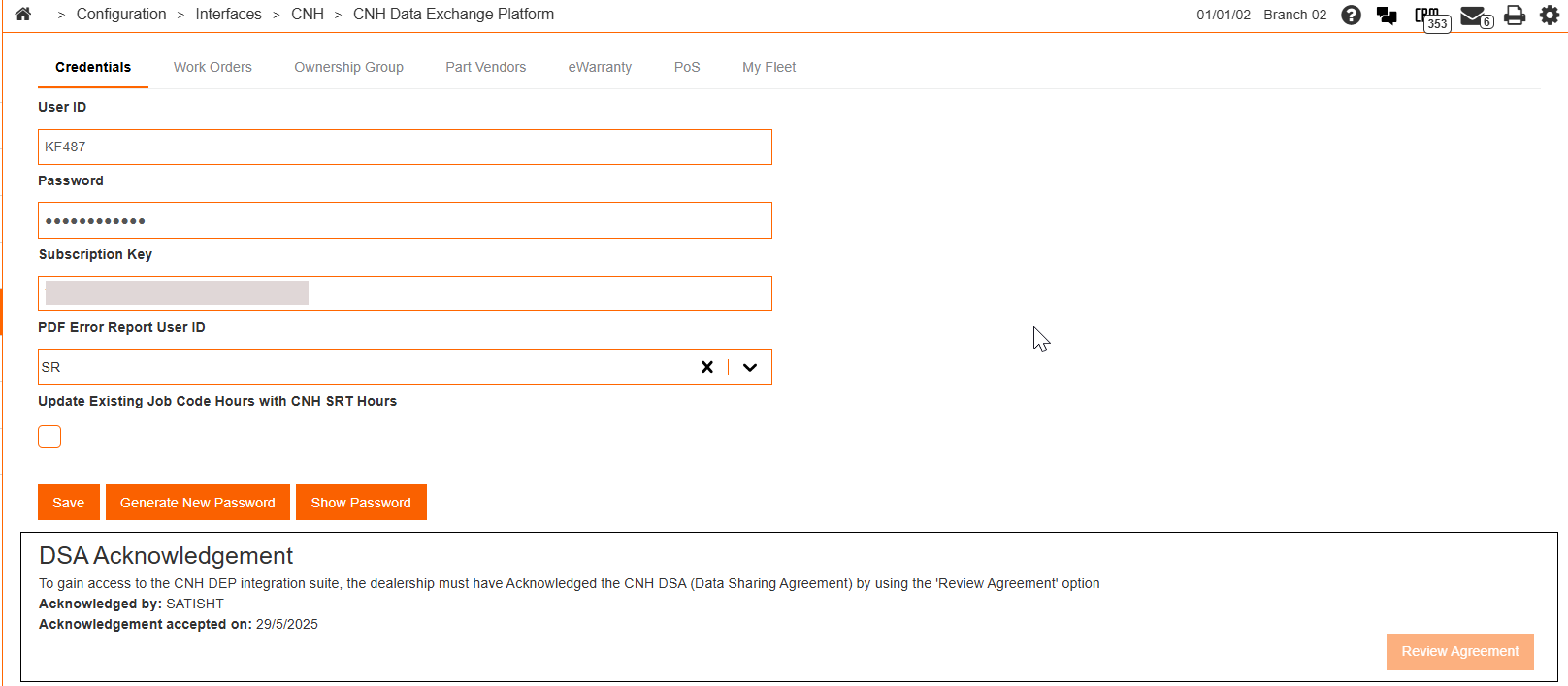
Fields on the Main tab are:
| Field | Description |
|---|---|
| PDF Error Report User ID | Select an IntelliDealer user ID from the drop-down. The selected user receives a PDF report from the nightly and manual CNH DEP processes (for example, work order, parts, and equipment invoice transmits). The report confirms successful transmissions and lists any errors that occurred so the recipient can follow up. Choose a user who actively monitors the CNH integration, such as the system administrator or the CNH integration owner. The user must already exist in IntelliDealer. See Troubleshooting for how to monitor transmits when no user is configured. |
| Update Existing Job Code Hours with CNH SRT Hours | If selected, when CNH Standard Repair Time (SRT) job codes are imported into a Work Order or Work Order Quote through the CNH: SRT Codes Lookup, any matching job code that already exists in IntelliDealer has its allotted hours overwritten with the SRT hours returned by CNH. If cleared, the existing job code keeps its current hours and the SRT hours returned from CNH are not applied to it. Enable this option when you want CNH job code hours to stay in sync with CNH's published repair times rather than using locally adjusted hours. This setting only affects the hours field; other job code details continue to follow the normal import behavior. |
Click Save to store your changes.
DSA Acknowledgment
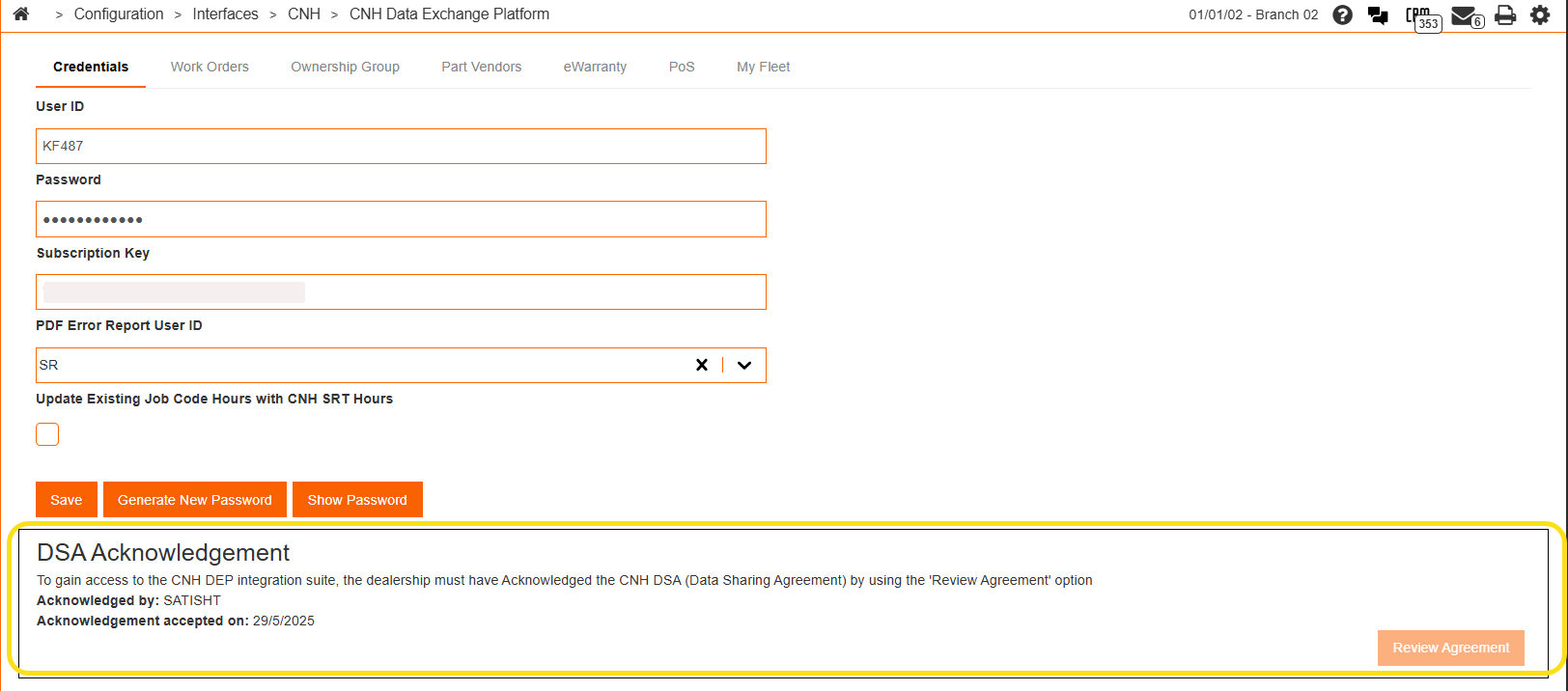
At the bottom of the Main tab is the DSA Acknowledgment. Review of this agreement is required for work order data to be transmitted to CNH.
The DSA Acknowledgment area displays who acknowledged the agreement and the accepted or declined date, when applicable. Click Review Agreement to open the agreement text. After you accept the agreement, the Review Agreement button is disabled.
Work Orders Tab
Use the Work Orders tab to configure which work order data is transmitted to CNH, map service component part numbers, and submit historical work order transmits.
Makes Sub-Tab
Use the Makes sub-tab to specify which equipment makes are included in the work order transmit for each company. The same make configuration is also used when equipment (whole goods) invoice data is transmitted through the PoS Tab.
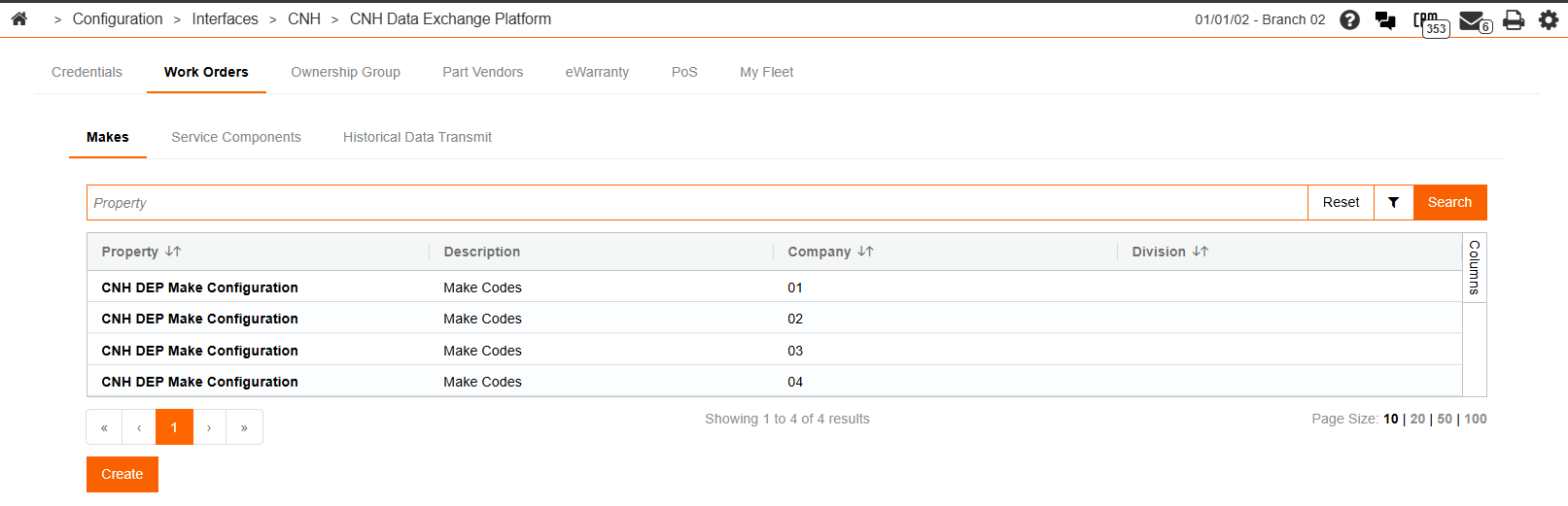
You can add one make configuration record per company. When you create a record, select the Company; the company cannot be changed after the record is saved. If your dealership operates multiple companies in IntelliDealer, create a separate record for each company. Work order transmits and equipment (whole goods) PoS transmits use the configuration for the company on the work order or invoice.
To add or edit a make configuration:
-
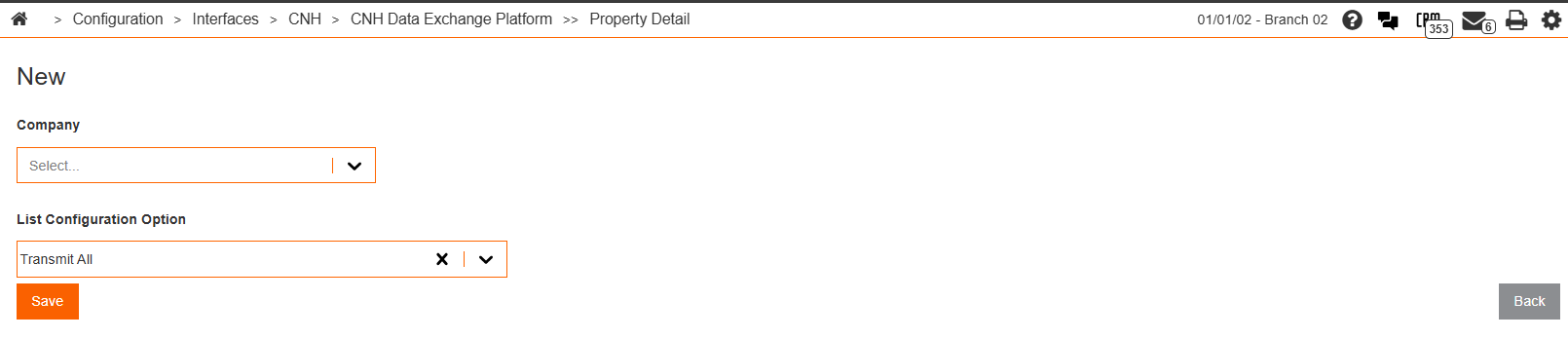
Click Create, or select an existing row and click Edit.
-
Select a Company from the drop-down.
-
Select a List Configuration Option. The options are:
-
Transmit All—transmit work orders for all equipment makes. No make list is required.
-
Transmit All Excluding Configured Options—transmit work orders for all makes except those you select in the make list.
-
Transmit Only Configured Options—transmit work orders only for the makes you select in the make list.
-
-
When the selected option requires a make list, search for or select equipment make codes in the make field.
-
Click Save.
Service Components Sub-Tab
On the Service Components sub-tab, you map IntelliDealer part numbers to CNH service components by location. Use this mapping to classify special parts and miscellaneous charges on CNH equipment units in the work order transmit.
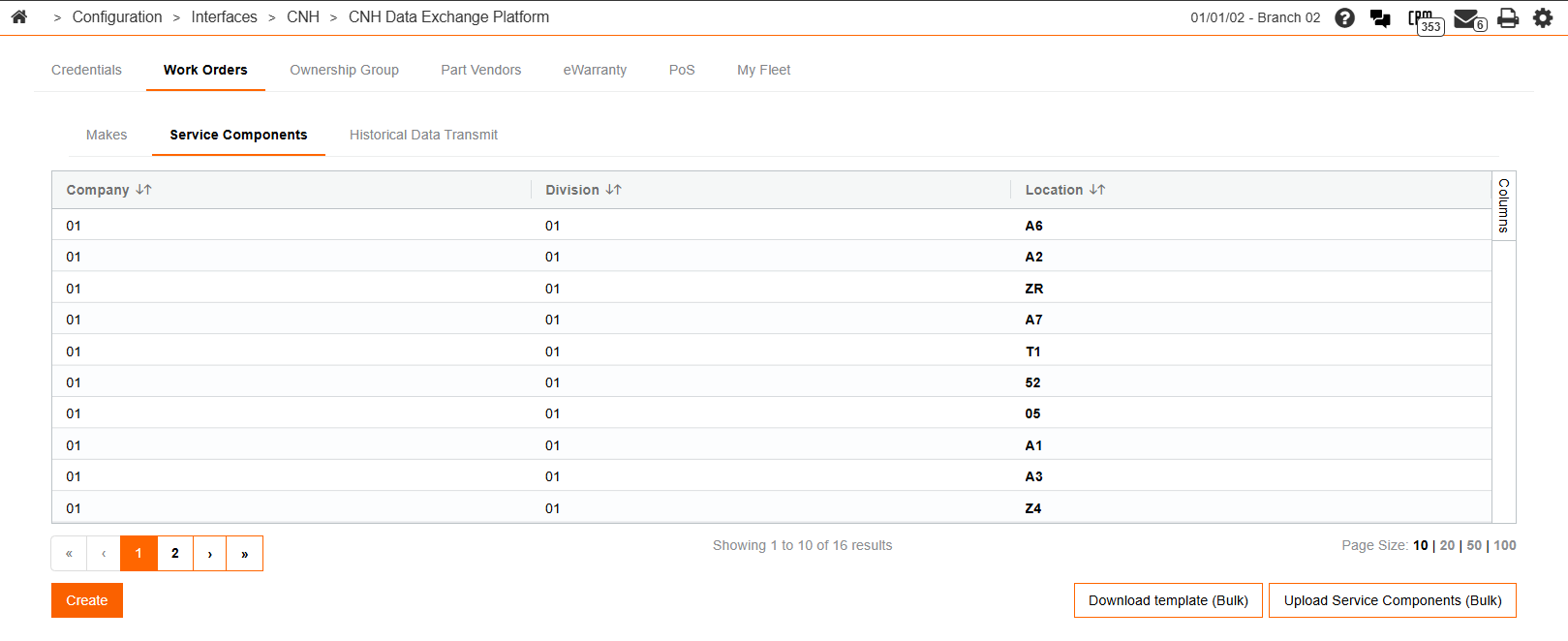
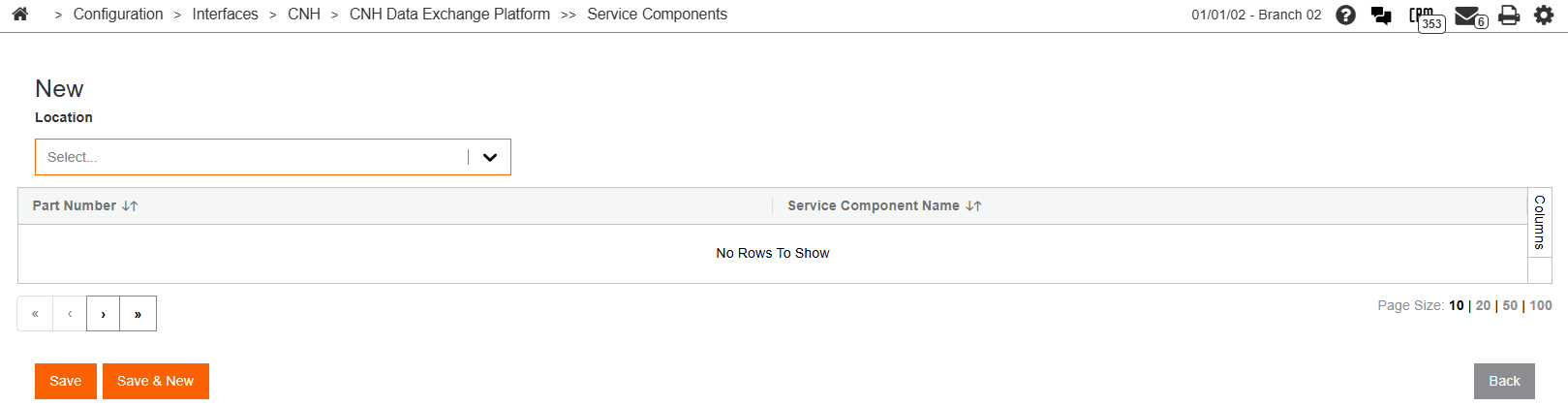
Each configuration record applies to one location (company, division, and location). Click Create to add a location, then add part number mappings in the grid. You can also maintain many mappings at once using bulk download and upload.
Dealers can post these charges as miscellaneous parts or as miscellaneous charges on a work order. When you bill an item as a Miscellaneous Charge, map the OTHER part number (see Special Part Numbers) that is tied to that charge in your miscellaneous charge configuration to the appropriate CNH service component. Any miscellaneous item on a work order that is not mapped to a service component is transmitted as though it were a part charged to the work order.
Buttons on the Service Components sub-tab are:
| Button | Description |
|---|---|
| Download template (Bulk) | Downloads an Excel workbook of the current service component mappings. The file name is cnh-service-component-mapping.xlsx. The workbook includes columns Company, Division, Location, Part Number, and CNH Service Component. The CNH Service Component column uses a drop-down list so each value matches a valid CNH option. When the download starts, a success message appears. |
| Upload Service Components (Bulk) | Opens a dialog where you select a .csv file. The file must include a header row with columns Company, Division, Location, Part Number, and CNH Service Component. After you choose a file, IntelliDealer submits the CNH Service Component Mapping Upload batch job to validate and apply the data, and a message confirms that the batch job was submitted. |
| Delete All | When you are viewing a location record, removes all part number mappings for that location after you confirm the deletion. Use this option when you need to clear a location and rebuild its mappings. |
To build a file from the Excel template, edit the workbook and use Save As to save a comma-separated values (.csv) file, then upload that file with Upload Service Components (Bulk). Validation is all-or-nothing: if any row is invalid, none of the rows from that file are applied. See Troubleshooting for how to review the CNH Service Component Mapping Upload batch job after upload.
Each CNH Service Component value in the upload file must match one of these names (spelling and punctuation as shown):
-
Extra Charge
-
Material
-
Travel
-
Freight
-
Antifreeze
-
Oil
-
Refrigerant
-
Tire
-
Diagnostics / Electronic Service Tool
-
Disposal Fee
-
Miscellaneous
-
Inspections
-
Dynamometer
-
Rental
-
Lease
-
Sublets
-
Sublet as Indicator
Historical Data Transmit Sub-Tab
Use the Historical Data Transmit sub-tab to submit a job that sends closed work order history to CNH for a rolling six-month window. Use this when you need to provide a historical extract or backfill work orders outside the standard DEP transmit process.
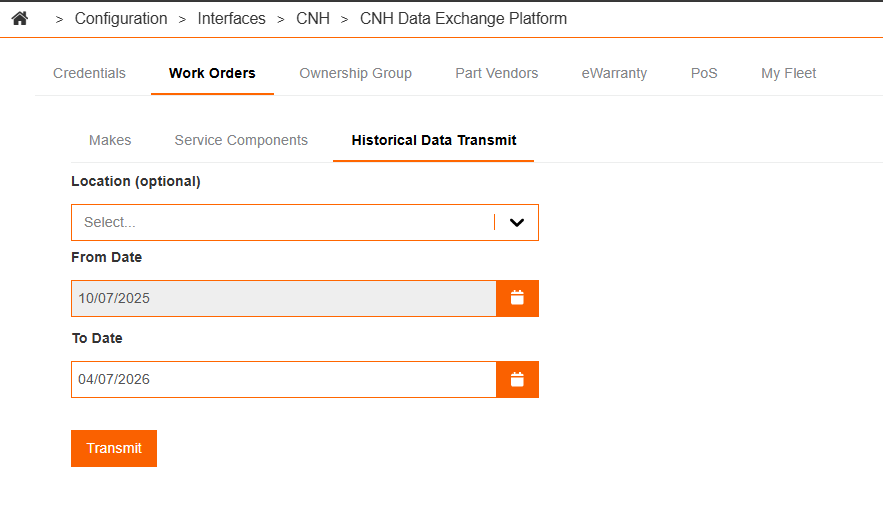
Fields on the Historical Data Transmit sub-tab are:
| Field | Description |
|---|---|
| Location | Optional. Select a company, division, and location to limit the transmit to that location. If you leave this blank, the job uses your default company and transmits closed work orders for all locations in that company that have a CNH CSPS dealer number configured. Work orders at locations without a CSPS dealer number are not included. |
| From Date | Read-only. This date is always six months before To Date so each run covers at most six months of closed work orders. |
| To Date | The end date of the range. You cannot select a date after today. When you change To Date, From Date updates to six months before the new To Date. |
Click Transmit. The system submits the CNH DEP Work Order Historical Data Transmit Manual Run batch job. When the job is queued, a success message appears. See Troubleshooting for how to review the job after it completes. CNH receives the extract through the agreed historical delivery path.
Only one six-month historical transmit can run at a time. Depending on the volume of data, the job can take a while to complete. While the job is running, you can monitor it in the Running Jobs area on Administration > Settings > Batch Jobs. When the job finishes, review the result in Job History on the same screen.
To cover more than six months (for example, several years of history), run additional transmits. Set To Date to the end of each earlier period so each run's six-month window lines up with the next without gaps or overlaps.
Each transmit uses the same work order rules you configure on the Work Orders tab: equipment makes on the Makes sub-tab determine which closed work orders are included, and Service Components mapping applies when the payload is built.
See also: PoS Tab for the comparable manual transmit pattern for parts and whole goods invoices.
Ownership Group Tab
On the Ownership Group tab, you configure the dealership's CNH primary Ownership Group account ID used in the work order data transmit. Each record applies to one division. See Configuration Scope for how division-level settings relate to other tabs.
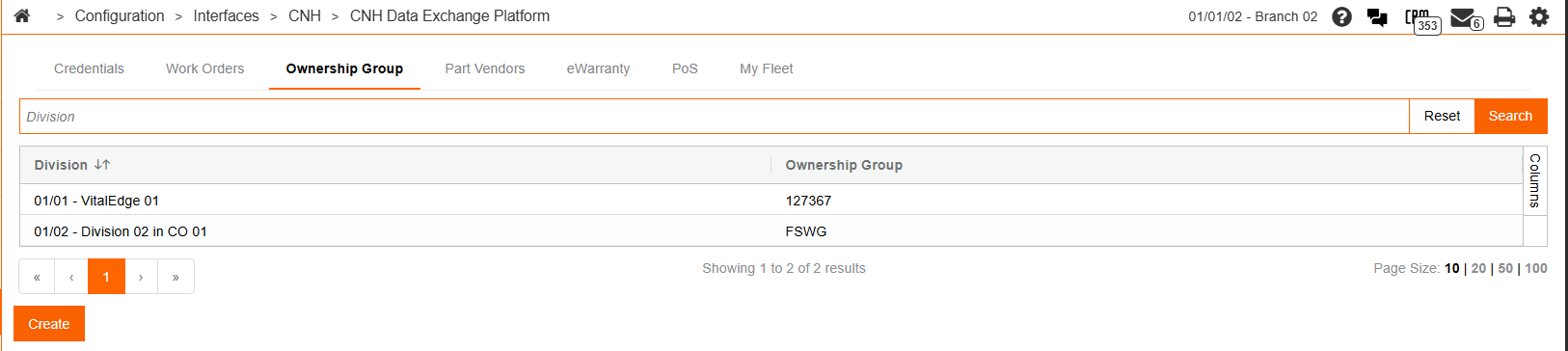
To add or edit an ownership group mapping:
-
Click Create, or select an existing row and click Edit.
-
Select the Division you are configuring for DEP.
-
Enter your CNH primary Ownership Group account ID.
If you are unsure, confirm this information with CNH during the on-boarding process.
-
Click Save.
Part Vendors Tab
On the Part Vendors tab, you configure which part vendors are included when parts invoice data is transmitted to CNH through the DEP point-of-sale process. Each record applies to one division. See Configuration Scope.
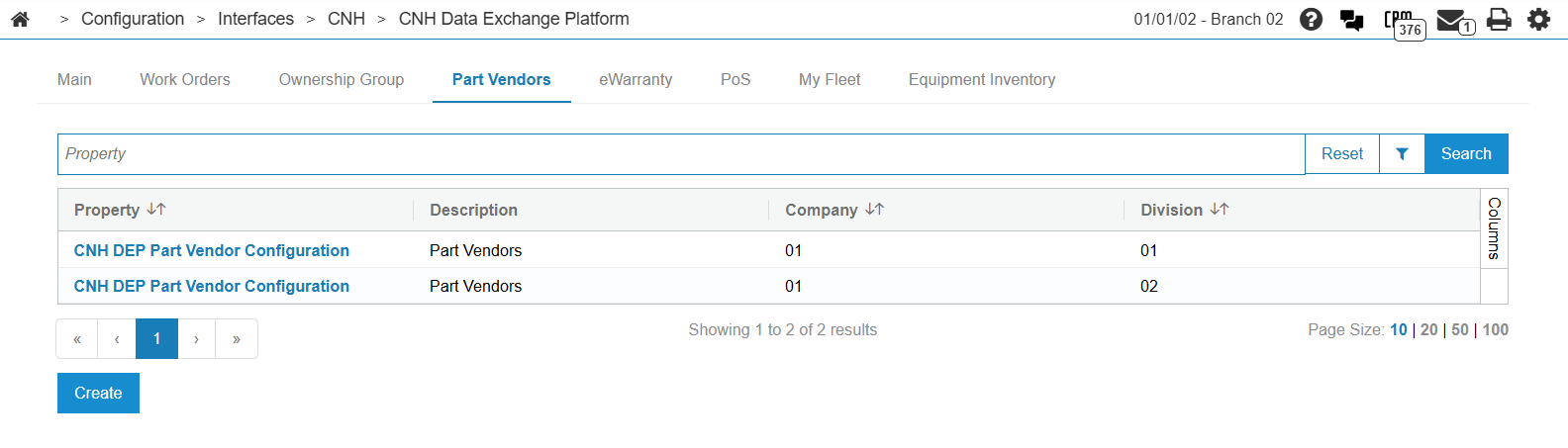
The Part Vendors tab lists each part vendor configuration record. The columns are:
| Column | Description |
|---|---|
| Property | The configuration name. Click the link to open the configuration for edit. |
| Description | A description for the record (Part Vendors). |
| Company | The company for the configured division. |
| Division | The division the part vendor list applies to. Parts invoice transmits for that division using this record. |
You can add one part vendor configuration record per division. When you create a record, select the Division; the division cannot be changed after the record is saved. If you operate multiple divisions, create a separate record for each division that transmits parts invoice data to CNH.
To add or edit a part vendor configuration:
-
Click Create, or click the Property name in an existing row and click Edit.
The New window opens or the record opens.
-
Fill in the fields described below.
-
Click Save.
Fields on the New Property Detail window are:
| Field | Description |
|---|---|
| Division | Select the division you are configuring. This field is available only when you create a record; it cannot be changed after you save. |
| Configuration Option |
Controls how the part vendor list is applied to parts invoice transmits for the selected division. The options are:
|
| Included Part Vendors |
Displayed when Configuration Option is Transmit Only Configured Options. Search for or select one or more part vendors to include in the transmit. The list shows vendors for the selected division with manufacturer code CASE. This field is hidden when Configuration Option is Transmit All. |
| Excluded Part Vendors |
Displayed when Configuration Option is Transmit All Excluding Configured Options. Search for or select one or more part vendors to exclude from the transmit. The list shows vendors for the selected division with manufacturer code CASE. This field is hidden when Configuration Option is Transmit All. |
eWarranty Tab
On the eWarranty tab, you configure automatic PIP (Product Improvement Program) and PPP (Purchased Protection Plan) searches and define which equipment makes are included in those searches by division.
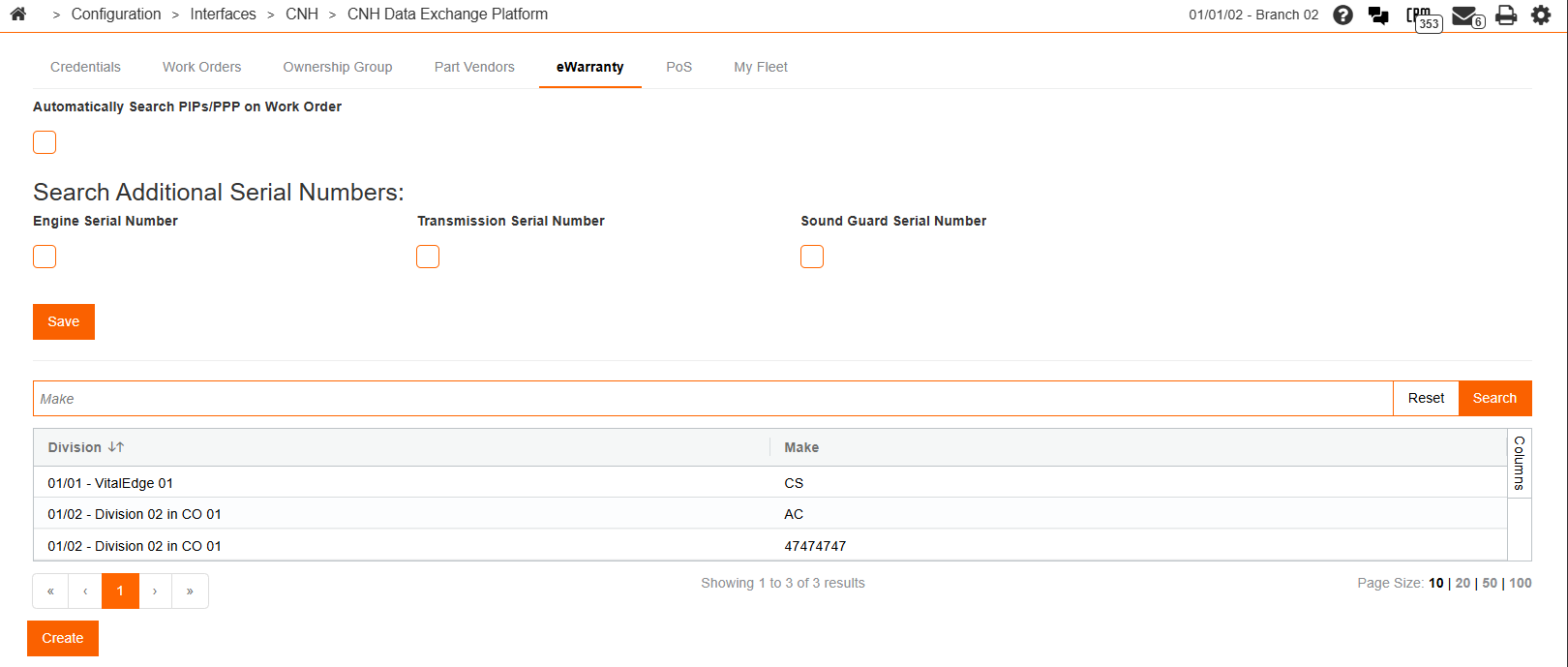
Fields on the eWarranty tab are:
| Field | Description |
|---|---|
| Automatically Search PIPs/PPP on Work Order | If selected, the system notifies the user when a unit has a PIP or PPP available. |
| Engine Serial Number | If selected, PIP/PPP searches also use the engine serial number in addition to the machine serial number. |
| Transmission Serial Number | If selected, PIP/PPP searches also use the transmission serial number in addition to the machine serial number. |
| Sound Guard Serial Number | If selected, PIP/PPP searches also use the Sound Guard serial number in addition to the machine serial number. |
Tip: Additional serial number searches can add time to searches when looking for PIP/PPP information. Unless you require the additional serial number fields, leave these cleared.
Click Save to store the search settings.
Below the search settings, the grid lists equipment make codes configured for PIP/PPP lookup by division. You can add one or more make codes for each division. To add a make:
-
Click Create.
-
Select the Division you are configuring.
-
Search for or enter the make code for the CNH equipment you are adding to the eWarranty searches.
-
Click Save.
To edit a make, click anywhere in the row.
PoS Tab
Use the PoS (Point of Sale) tab to submit a manual job to transmit parts or equipment invoice data to CNH for a date range. Use this when you need to provide a historical extract or back-fill point of sale invoices outside the standard DEP transmit process. Before you run a historical PoS transmit, configure the Part Vendors Tab for parts invoices and the Makes Sub-Tab for equipment (whole goods) invoices.
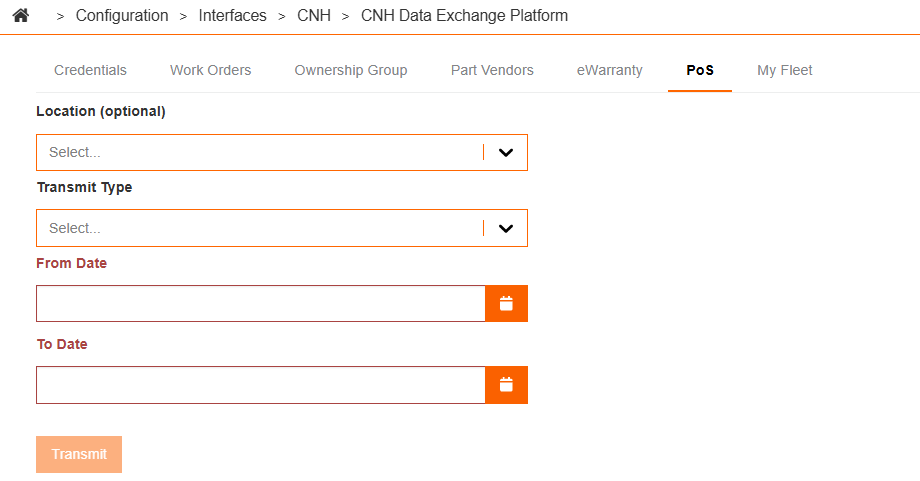
Fields on the PoS tab are:
| Field | Description |
|---|---|
| Location | Optional. Select a company, division, and location to limit the transmit to that location. If you leave this blank, the job runs for all locations. |
| Transmit Type | Select All, Parts, or Whole Goods to choose whether parts invoice data, equipment (whole goods) invoice data, or both is transmitted. |
| From Date | Read-only. This date is always six months before To Date so each run covers at most six months of invoice data. |
| To Date | The end date of the date range for the transmit. You cannot select a date after today. When you change To Date, From Date updates to six months before the new To Date. |
Fill in the fields, then click Transmit. The system submits the CNH PoS - Manual batch job. When the job is queued, a success message appears. See Troubleshooting for how to review the job after it completes.
Parts invoice transmits use the vendor configuration on the Part Vendors tab for the division on each invoice. Equipment (whole goods) invoice transmits use the make configuration on the Makes sub-tab under Work Orders for the company on each invoice.
To cover more than six months (for example, several years of history), run additional transmits. Set To Date to the end of each earlier period so each run's six-month window lines up with the next without gaps or overlaps.
See also: Historical Data Transmit Sub-Tab on the Work Orders tab for the equivalent work order historical pattern.
My Fleet Tab
On the My Fleet tab, you configure the default CNH brand used when users open CNH My Fleet. Each record applies to one location (company, division, and location). The grid lists each location and its default brand.
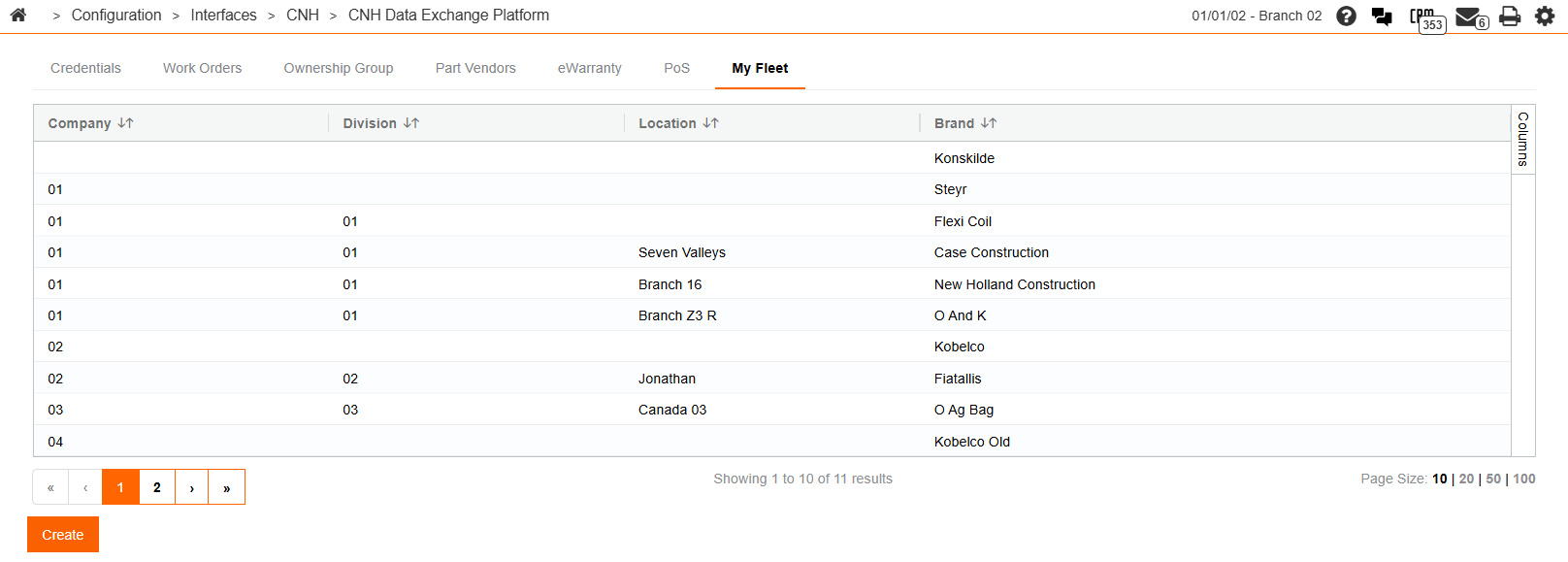
To add a default brand:
-
Click Create.
-
Select Company, Division, and Location, then select a Brand from the drop-down (for example, Case IH, New Holland, Steyr).
-
Click Save.
You can edit or delete existing rows from the grid.
When a user opens CNH My Fleet from the menu, an Equipment Profile, or a Work Order, the system uses the default brand for that user's location so the correct CNH brand data is displayed.
Equipment Inventory Tab
Use the Equipment Inventory tab to configure which equipment makes are included in the daily equipment inventory transmit to CNH and submit historical equipment inventory transmits.
Makes Sub-Tab
On the Makes sub-tab, you specify which equipment makes are included in the equipment inventory transmit for each company.
You can add one make configuration record per company. When you create a record, select the Company; the company cannot be changed after the record is saved. If your dealership operates multiple companies in IntelliDealer, create a separate record for each company.
To add or edit an equipment inventory make configuration:
-
Click Create, or select an existing row and click Edit.
-
Select a Company from the drop-down.
-
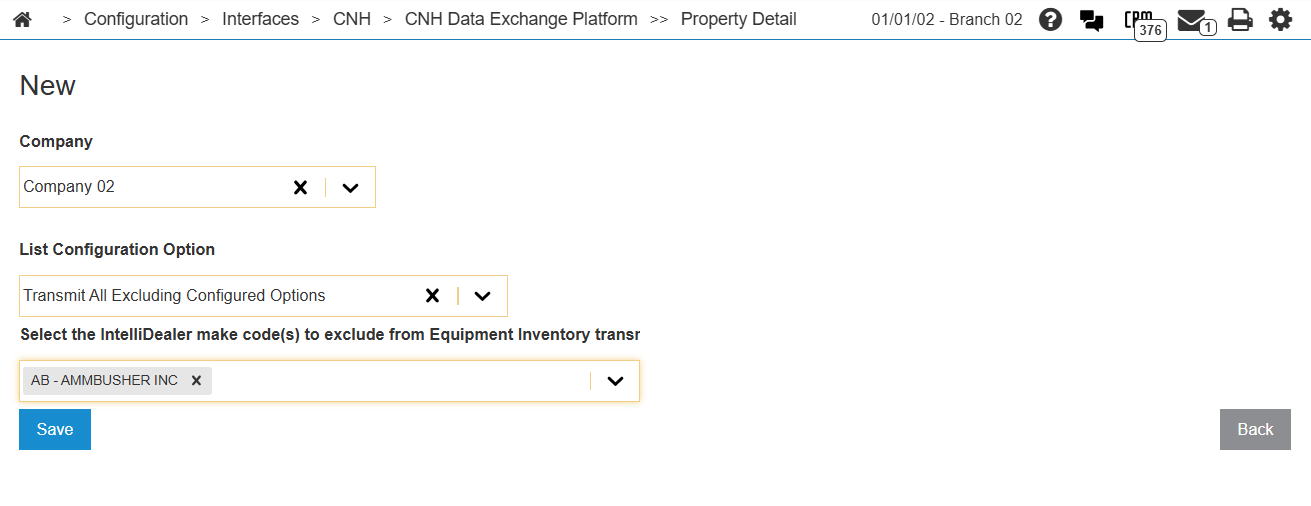
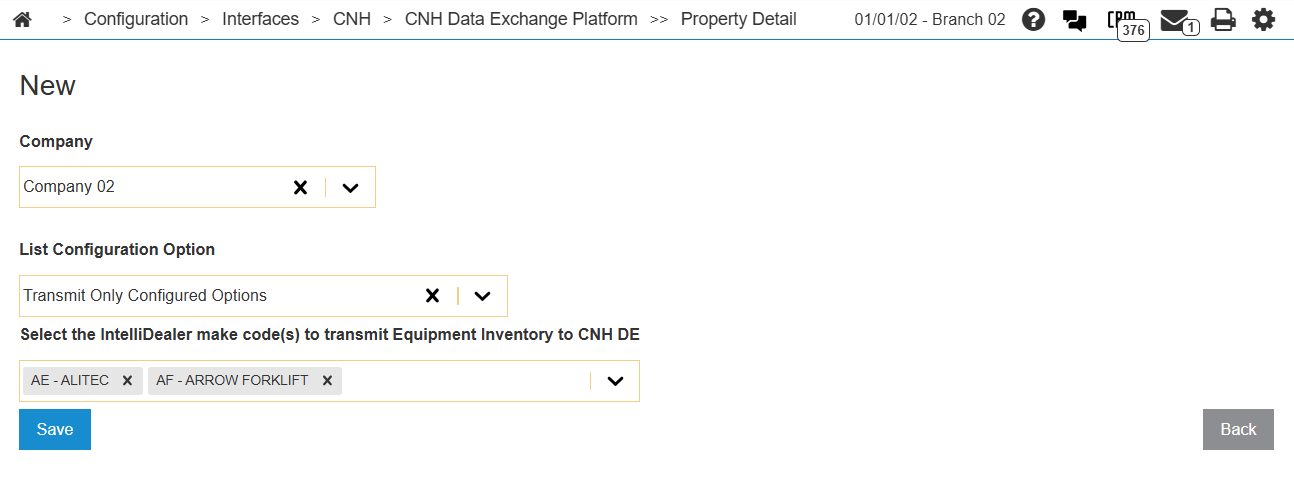
Select a List Configuration Option. The options are:
-
Transmit All—transmit equipment inventory for all equipment makes. No make list is required.
-
Transmit All Excluding Configured Options—transmit equipment inventory for all makes except those you select in the make list.
-
Transmit Only Configured Options—transmit equipment inventory only for the makes you select in the make list.
-
-
When the selected option requires a make list, search for or select equipment make codes in the make field.
-
Click Save.
Historical Data Transmit Sub-Tab
Use the Historical Data Transmit sub-tab to submit a job that sends equipment inventory history to CNH based on the date each unit was added to inventory. Use this when you need to provide a historical extract or back-fill equipment inventory outside the standard daily transmit process.
Fields on the Historical Data Transmit sub-tab are:
| Field | Description |
|---|---|
| Location | Optional. Select a company, division, and location to limit the transmit to that location, or select All Locations to include every location. |
| From Date Added | The start of the date-added range. The start date cannot be after the end date. |
| To Date Added | The end of the date-added range. You cannot select a date after today. The date range cannot span more than six months. |
Click Transmit. The system submits the CNH CRM Equipment Inventory Historical Data Transmit Manual Run batch job. When the job is queued, a success message appears. See Troubleshooting for how to review the job after it completes.
Each transmit uses the make rules you configure on the Makes sub-tab to determine which equipment units are included.
To cover more than six months of history, run additional transmits with consecutive date-added ranges that do not overlap or leave gaps.
Price File Tab
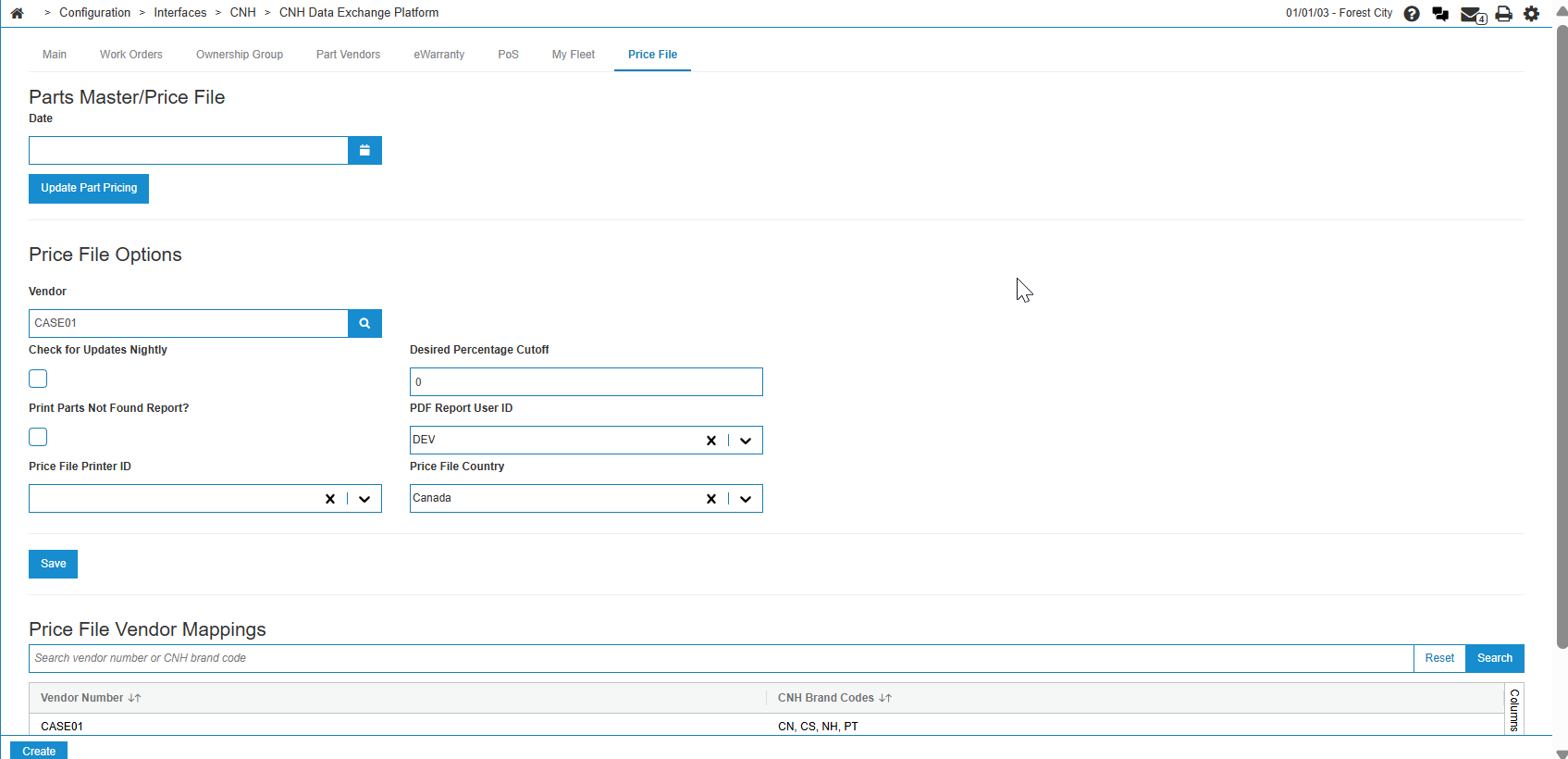
Use the Price File tab to configure and run CNH DEP daily parts pricing updates. IntelliDealer retrieves list and cost changes from the CNH DEP API for existing parts on your master price file, writes a IntelliDealer-formatted price file (CNH158), and runs the parts price update program (#PARTPRC). New parts are not added from this feed.
Prerequisites:
-
Feature 6429 - CNH Data Exchange Platform must be enabled.
-
Valid DEP credentials must exist on the CNH: Credentials screen.
-
The Vendor on this tab must exist on your master price file and in price update control (PRUCONT).
-
At least one Price File Vendor Mapping row must map the vendor to one or more CNH brand codes before a price file run can process records.
Parts Master/Price File
Use this section to submit a manual CNH DEP price file job for a selected validity date.
| Field or button | Description |
|---|---|
| Date | The CNH price validity date to request from the DEP API. You can select today or a past date. Future dates are not allowed. When you leave this field blank for a manual run, IntelliDealer uses yesterday's date. |
| Update Part Pricing | Submits the CNH DEP Price File Manual Run batch job for the selected validity date. A success message confirms that the job was queued. Review job history on Administration > Settings > Batch Jobs after the job completes. See Troubleshooting for how to investigate job results. |
Price File Options
This feature is currently in beta.
Configure processing and reporting options for nightly and manual CNH DEP price file runs. Click Save after you change these fields.
Note: This option does not replace the existing monthly price file process and acts as an interim update between monthly files.
| Field | Description |
|---|---|
| Vendor | Required. The parts vendor code used for the CNH DEP price file run. This vendor must exist on the master price file (PARTPRC) and in price update control. Only parts on this vendor that match the configured CNH brand and country filters are updated. |
| Check for Updates Nightly | When selected, IntelliDealer runs the CNH DEP Price File Nightly Job each night at 9:00 PM server time. The nightly job uses yesterday as the validity date. When cleared, price updates run only when you click Update Part Pricing. |
| Desired Percentage Cutoff | Numeric value passed to #PARTPRC. Parts whose list or cost change is below this percentage threshold are not updated during the price file run. |
| Print Parts Not Found Report | When selected, IntelliDealer prints the parts not found report when #PARTPRC produces it. Because CNH sends pricing updates only for parts that changed, many parts on the vendor are not included in each daily feed. |
| PDF Report User ID | The IntelliDealer user who receives the CNH DEP Price File Report PDF when the price file job completes. The user must be active. When this field is blank, IntelliDealer uses the PDF Error Report User ID from the Main Tab if one is configured. |
| Price File Printer ID | Printer used for price file reports generated during #PARTPRC, such as the parts not found report. |
| Price File Country | Required. Select United States or Canada. IntelliDealer includes only CNH price records whose currency and country match this setting. |
Price File Vendor Mappings
Use the Price File Vendor Mappings grid to map each parts vendor to the CNH brand codes that vendor receives through the DEP daily pricing API. Each vendor can appear on one row with one or more brand codes selected.
The grid columns are:
| Column | Description |
|---|---|
| Vendor Number | The parts vendor code that receives CNH DEP price updates for the selected brand codes. |
| CNH Brand Codes | One or more CNH brands whose daily price records apply to this vendor. The brand codes sent by CNH and stored in the mapping are CS (CASE), NH (NEW HOLLAND), PT (POWERTRAIN), and CN (CASE - NEW HOLLAND). |
To add or edit a vendor mapping:
-
Click Create, or select a row and click Edit.
-
Enter or search for the Vendor Number.
-
Select one or more CNH Brand Codes. At least one brand code is required.
-
Click Save.
You can search the grid by vendor number or brand code. Each vendor can have only one mapping row; edit the existing row to add or remove brand codes.
Process Walkthrough
When a manual or nightly CNH DEP price file job runs, IntelliDealer:
-
Authenticates to CNH DEP and requests price records from the DEP API for the validity date, one page at a time.
-
Skips records that do not match the configured vendor brand mappings, Price File Country, or vendor on PARTPRC.
-
Maps CNH list and net prices to the IntelliDealer price file format and writes the CNH158 file.
-
Runs #PARTPRC to update list and cost on the master price file and parts master for eligible parts.
-
Writes detailed status lines to batch job history and, when a PDF user is configured and active, generates the CNH DEP Price File Report PDF.
CNH makes daily pricing files available around 1:00 AM CST. Most daily updates contain fewer than 100 parts and are processed through the DEP API. When CNH sends more than 5,000 records for a validity date, the job stops with a message that SFTP processing is required; large feeds are not processed through the API in the current release.
Parts that CNH includes in the feed but that are not loaded on the configured vendor in PARTPRC are skipped. The job can still complete successfully when none of the updated CNH parts exist in your inventory.
See also: IntelliDealer Batch Jobs for job names and schedules, and Configuration: Master Price Files for master price file setup.