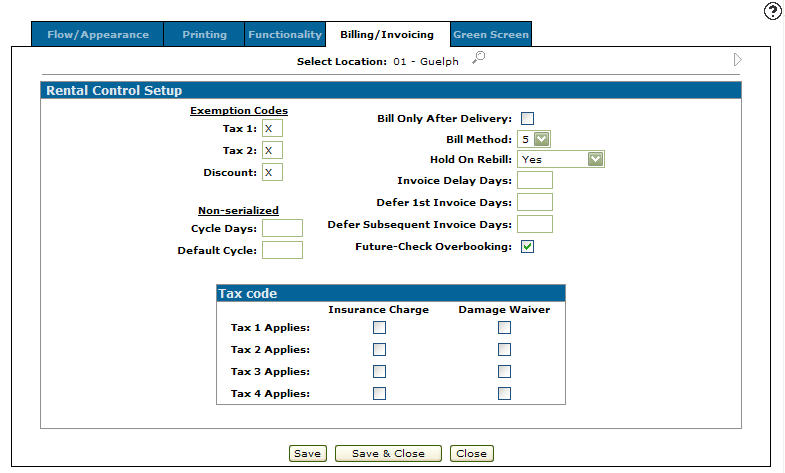
Rental Control Setup - Billing/Invoice

Use the Billing/Invoice tab to set up rental billing/invoice options within the Rental Counter module. The Rental Counter module is very flexible and can be customized using various control settings, depending on the parameters you wish to include in your your Rental Counter module.

To open the Billing/Invoice tab, from anywhere within IntelliDealer navigate to Configuration > Rental> Rental Control Setup.

Use the search field at the top of the Billing/Invoicetab to select the location to be configured. Click the Previous or Next icon to scroll to the next branch location or back to a previous branch location.

Topic in this section

Rental Control Setup - Billing/Invoicing

  1. Navigate to Configuration > Rental > Setup > Rental Control Setup.

    Click the Billing/Invoicing tab.

    Note:  Click the Previous or Next icon to scroll to the next branch location or back to a previous branch location.

  2. The options on the Billing/Invoicing tab are completely customizable allowing the user to set up only the functions that they wish to apply to their rental system.

    • Exemption Codes—enter the Tax 1, Tax 2 and Discount exemption codes into the appropriate fields. This code is usually X.

    • Cycle Days—produces a billing cycle suitable for non-serialized rental shops. This field adjusts the invoice print date based on the Date Out on the contract.

    • Default Cycle—used for a Cycle Rent type of contract. If this type of contract is created the system defaults the invoice cycle according to the number of days entered.

    • Bill Only After Delivery—places the rental contract on Hold until the Outbound Rental Traffic ticket has been coded as 'Received' at the customer's site.

    Billing Methods
    Type Description
    1. (Pre-Bill with Billing Cycle Optimization) An invoice is produced at the start of the rental period. Optimization occurs during the billing cycle of the contract. In other words, if it goes out on a weekly, it rolls up to a monthly. The system does not calculate the optimum combination of rental durations and quantities upon return.
    2. (Pre-Bill with Return Optimization) An invoice is produced at the start of the rental period. No automatic optimization occurs during the billing cycle of the contract. In other words, if it goes out on a weekly, it does not roll up to a monthly. It only increases the quantity of the currently assigned duration. Optimization occurs during the return recalculation.
    3. (Pre-Bill with No Optimization) Invoice at the start of the rental period. No optimization occurs during the billing cycle of the contract. The system does not calculate the optimum combination of rental duration and quantities upon return.
    4. (Post-Bill with Optimization) An invoice is produced 1 day before the end of the rental period. Optimization occurs throughout the billing cycle of the contract.
    5. (Pre-Bill with Optimization) An invoice is produced at the start of the rental period. Optimization occurs throughout the billing cycle of the contract.

    The Hold on Bill options:

    • Yes—a message appears notifying that a contract has been placed on hold pending a required authorization number

    • No—indicates no hold on rebilling

    • Cash Code—indicates that the contract should be held if the CASHTAB table switch HOLD RENTAL COUNTER CONTRACT ON REBILL for the contract's cash code is set to Yes

    • Invoice Delay Days—postpones the creation of an invoice by the number of days entered.

    • Defer 1st Invoice Days—postpones the creation of an invoice by the number of days entered. This may optionally pertain to only the first invoice generated by a contract.

    • Defer Subsequent Invoice Days—postpones the creation of an invoice by the number of days entered. This may optionally pertain to only subsequent invoices produced after the first invoice.

    • Future - Check Overbooking—performs a future-check overbooking of potential availability conflicts with existing reservations.

    • Print Invoices in Billing Run—if selected, the system prints rental invoices when generating a rental billing run.

    • Print Future Preliminary Report—allows the user to print the Future Billing Preliminary report (RM034-F) when running a rental billing run preliminary.

  3. After selecting your settings on the Billing/Invoicing tab for the selected location, click the Save button to apply the changes to the rental system.

Screen Description

The fields on the Billing/Invoice tab are:

Rental Control Setup
Field Description
Exemption Codes
Tax 1 The exemption code for Tax 1. This code is usually ‘X’.
Tax 2 The exemption code for Tax 2. This code is usually ‘X
Discount The exemption codes for Discounts. This code is usually ‘X’.
Non - Serialized
Cycle Days Produces a billing cycle suitable for non-serialized rental shops. This field adjusts the invoice print date based on the Date Out on the contract. For example, set this field to 28 for a 28 day billing cycle. The first invoice is printed on the first day of the contract.
Bill Only After Delivery If using the Traffic system, selecting this option places the rental contract on Hold until the Outbound Rental Traffic ticket has been coded as ‘Received’ at the customer’s site. This way, no rental invoice is produced by the system until the customer is in possession of the equipment. If this field is not selected, invoices are generated regardless of the traffic ticket status.
Bill Method

Set to a numeric value, where:

  • 1 Pre-Bill with Billing Cycle Optimization—An invoice is produced at the start of the rental period. Optimization occurs during the billing cycle of the contract. In other words, if it goes out on a weekly, it will roll up to a monthly. The system does not calculate the optimum combination of rental durations and quantities upon return.

  • 2 Pre-Bill with Return Optimization—An invoice is produced at the start of the rental period. No automatic optimization occurs during the billing cycle of the contract. In other words, if it goes out on a weekly, it will not roll up to a monthly. It only increases the quantity of the currently assigned duration. Optimization occurs during the return recalculation.

  • 3 Pre-Bill with No Optimization—An invoice is produced at the start of the rental period. No optimization occurs during the billing cycle of the contract. The system does not calculate the optimum combination of rental duration and quantities upon return.

  • 4 Post-Bill with Optimization—An invoice is produced one day before the end of the rental period.

    Warning: Using this option, you must run the billing every day because optimization occurs throughout the billing cycle of the contract, and otherwise invoices may not get processed.

  • 5 Pre-Bill with Optimization—An invoice is produced at the start of the rental period. Optimization occurs throughout the billing cycle of the contract.

Hold on Rebill

Options are:

  • Yes to have a message appear notifying that a contract has been placed on hold pending a required authorization number. No invoice will be created until the authorization number has been entered.
  • No to indicate no hold on rebilling.
  • Cash Code to indicate that the contract should only be held if the Hold Rental Counter Contract On Rebill switch has been activated for the cash code on the contract (as specified Configuration > General Ledger > Accounts Receivable > Cash Codes.)
Invoice Delay Days

If desired, specify the number of days by which to postpone the creation of any invoice. Both Defer 1st Invoice Days and Defer Subsequent Invoice Days override this field. In other words, if either of the other fields are set, then this field is ignored.

Defer 1st Invoice Days

If desired, specify the number of days by which to postpone the creation of the first invoice only. If this field is not set and Invoice Delay Days has a setting, that value is used.

Defer Subsequent Invoice Days

If desired, specify the number of days by which to postpone the creation of the subsequent invoices after the first one. If this field is not set and Invoice Delay Days has a setting, that value is used.

Future - Check Overbooking Allows the user to perform a check for overbooking in the future, to identify potential availability conflicts with existing reservations.
Print Invoices In Billing Run

If selected, the system prints rental invoices when generating a rental billing run. If not selected, no rental invoices are printed when generating a rental billing run.

Note:  If you are licensed for feature number 6206 and are using the Rental Rate Authorization system, this parameter also controls when authorization requests must be sent for approval; if selected, requests are required immediately after attempting to override a rate on either the Details tab,Invoicing tab, Extended Details screen, Package Price/ Discount screen, or Return Summary screen; if not selected, requests are required after overriding a rate and clicking Print Invoice on the Invoicing tab.

Print Future Preliminary Report

Allows the user to print the Future Billing Preliminary report (RM034-F) when running a rental billing run or billing run preliminary. If not selected, the system will not print the Future Billing Preliminary report when running a rental billing run or billing run preliminary.

The Tax Code section of the Billing/Invoice tab allows you to apply tax codes 1 through 4 to either insurance waiver, damage waiver or both. The checkboxes indicate whether the specified tax number applies to insurance waiver, damage waiver or both.

Use these buttons to complete your work on the Billing/Invoice tab:

Button Function
Save Saves changes made to the Billing/Invoice tab.
Save & Close Saves changes made to the Billing/Invoice tab and closes the screen.
Close Closes the Billing/Invoice tab without saving changes and returns to the Configuration Quick Links screen.

Data Source: RMCTL

Security: 999 - Configuration

Revision: 2026.02